How Long to Mine 0.005 BTC? Working a Reader's Question
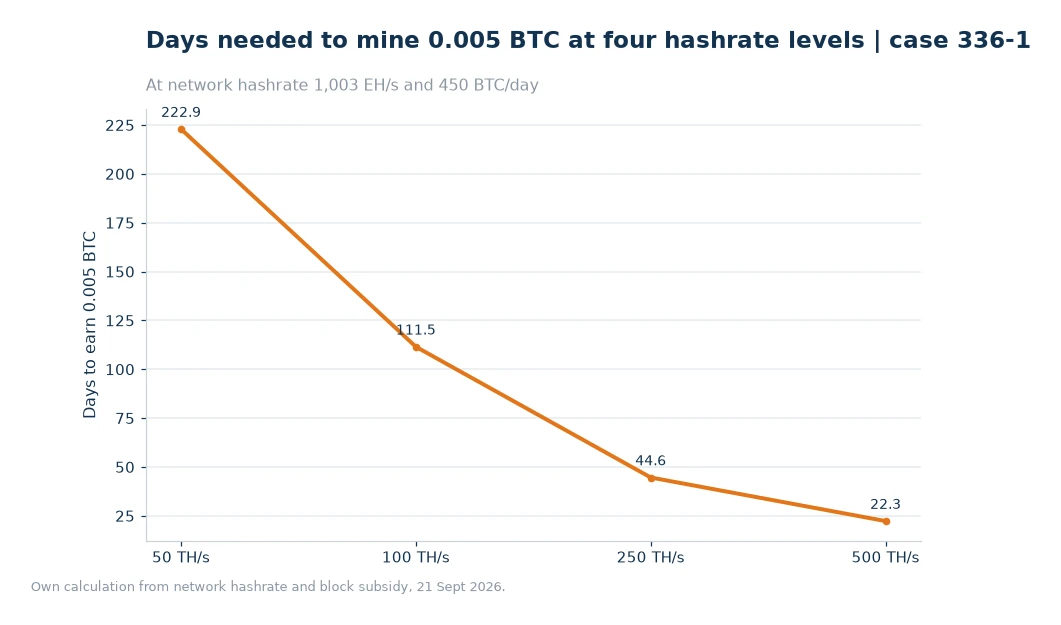
A reader wrote in asking how long it takes to mine 0.005 BTC, and whether the answer is "months" or "never". It is neither. At 100 TH/s the target takes about 111.5 days at the 21 Sept 2026 network figures, or roughly 16 weeks; at 500 TH/s it takes 22.3 days. The answer depends almost entirely on one number the question left out: hashrate.

Key takeaways
- 0.005 BTC is worth about $423 at $84,692 per BTC, whatever the hashrate.
- At 50 TH/s the wait is 222.9 days, at 100 TH/s it is 111.5, at 250 TH/s it is 44.6 and at 500 TH/s it is 22.3.
- Only two of those four timelines fit inside a season; the other two span one.
- The wait is set by hashrate, the network total and the subsidy — not by which pool you join.
The question, restated precisely
"How long does it take to mine 0.005 BTC" has four hidden variables: the hashrate of the hardware, the network total, the block subsidy and the fee scheme. The last one changes the answer by a few percent. The first three change it by orders of magnitude. Any answer that does not name them is a guess wearing a number.
So the useful reply is a small table rather than a sentence. Give the reader the rate at four sizes and let them find the row that matches their machine. If they do not know their machine's hashrate, the question is not yet answerable, and saying so is more honest than picking a middle value.
There is a version of the question that is answerable without any hardware at all: how long would it take the whole network to produce 0.005 BTC? The answer is a few minutes. That contrast is the cleanest way to explain why individual hashrate dominates everything else, and why two readers with the same target can be living in different years.
It also explains why answers to this question online disagree so much. Each one was written for a different hashrate, a different difficulty and a different year, and the numbers were rarely labeled with their assumptions. A table with a rate column at least makes the assumptions visible.
Why the answer is a range, not a number
Even with the hashrate fixed, the answer is an average rather than a schedule. The network total drifts, the difficulty adjusts every 2,016 blocks, and any given machine may lose hours to a reboot or a heatwave. The figure below is the center of a distribution, not a promise about a Thursday.
There is also a definitional trap. A pool pays for shares, so the coins arrive steadily even though the pool finds blocks irregularly. Someone mining alone would instead wait for a block, which for small hardware is a very different experience. When a reader says "mine", they may mean either of those, and the timelines only match over long periods.
That difference matters to how the answer feels. A pooled miner at 100 TH/s sees a credit every hour and can stop at any point with coins already in hand. A solo miner at the same hashrate sees nothing for a very long time and then, if a block arrives, sees a large amount at once. Same average, opposite experience, and the second one is why the word "never" creeps into the question.
The same five thousandths at four sizes
The last column is the one that tends to land with readers: how much of a year the wait consumes. Half a year for a small machine and three weeks for a mid-size one are the same coin amount, which makes the scale difference concrete.
| Hashrate | BTC per day | Days to 0.005 BTC | Weeks | Share of a year |
|---|---|---|---|---|
| 50 TH/s | 0.00002243 | 222.9 | 31.8 | 61.1% |
| 100 TH/s | 0.00004486 | 111.5 | 15.9 | 30.5% |
| 250 TH/s | 0.00011215 | 44.6 | 6.4 | 12.2% |
| 500 TH/s | 0.00022430 | 22.3 | 3.2 | 6.1% |
Worked example
Here is the full path for the 100 TH/s reader, which is the case the original question most likely described.
- Network output per terahash: 450 BTC a day ÷ 1,003,000,000 TH/s = 0.0000004486 BTC.
- 100 TH/s × 0.0000004486 = 0.00004486 BTC a day.
- Target ÷ daily output: 0.005 ÷ 0.00004486 = 111.45 days, reported as 111.5.
- In weeks: 111.45 ÷ 7 = 15.9.
- As a fraction of a year: 111.45 ÷ 365 = 30.5%.
- In dollars: 0.005 × 84,692 = $423.46.
- At 500 TH/s, five times the hashrate, the same division gives 22.29 days, which is the 22.3 in the chart.
What changes the answer most
Ranked by effect: hashrate first, the network total second, uptime third, the fee scheme fourth. A doubling of hashrate halves the wait. A 20% rise in the network total lengthens it by a quarter. Two days of downtime a month adds about 7% to the calendar. A move between the two fee schemes shifts the coin amount by a couple of percentage points, which is the smallest of the four.
Readers tend to ask about the fourth item and ignore the first three, probably because the fee scheme is the one thing a pool page displays prominently. The honest answer points back at the hardware and the network, where the leverage actually is.
One more variable deserves a mention because it is invisible in the sum: the price of the coin. It does not change how many days the target takes, since 0.005 BTC is 0.005 BTC at any price. It changes what the wait is worth when it ends, and a reader who is really asking "is this worth doing" is asking a price question wrapped inside a duration question.
Where Pool Luck and the Pool Hashrate fit in
Pool Luck describes how a pool's block finds compare with expectation over a window. Under PPLNS it reaches the miner directly, because the payout is the miner's slice of what was actually found across the last five difficulty rounds. Under PPS+ the block-reward component is settled hourly against difficulty, so the reader's series looks like a straight line rather than a set of steps.
The ViaBTC Pool Hashrate figure belongs in the same paragraph because it tells the reader how deep the pool is. A pool with a larger share of the network finds blocks more often, which shortens the PPLNS window in wall-clock terms and makes a single miner's payments settle toward the average sooner.
Frequently asked questions
Is 0.005 BTC a realistic first target?
Yes for a mid-size machine: at 250 TH/s the wait is 44.6 days, while at 50 TH/s it stretches to 222.9 days, so the target is realistic only relative to the hardware.
Does the answer change if I switch pools?
Only slightly. The listed rates differ by a couple of percentage points between PPS+ and PPLNS, while hashrate and the network total move the timeline by multiples.
Why is my actual arrival later than 111.5 days?
Because the calculation assumes continuous uptime at full effective hashrate and a steady network total; downtime, throttling or a rising network each lengthen the wait.
An answer you can re-check
Write the sum in the margin of whatever you use to track the machine: 450 divided by the network total in terahashes, times your hashrate, then divide the target by that. Re-run it on the first of each month. The number will move, and watching it move is more informative than any single figure in this article.
The Statistics page supplies the current network total, and the Profit Calculator does the same division in dollars if a reader prefers a daily figure to a countdown. Either way, the structure of the answer stays the same: target, rate, days.
Sources: ViaBTC statistics, calculator and pool state pages; network figures read 21 Sept 2026 — hashrate about 1,003 EH/s, difficulty 132.76 T, 3.125 BTC per block, 144 blocks a day, BTC $84,692. Published 24 Oct 2026. Timelines hold difficulty constant and presume no downtime[1].