Why Text-Only Generation Avoids Some Risks
A platform that generates text and no imagery removes several categories of problem before they can occur, and the disclosure here is unusually direct: Crushon's compliance statement describes the content as AI-generated text, states that it depicts no real person, and confirms that the site does not produce images or video of its own. That makes the verification question far simpler than it would be for a media library, and it applies to a modest volume — 16 sessions a month at 30 minutes each is 8 hours, or about 1,200 messages at 40 a day.

Key takeaways
- Text-only generation means there is no media to verify, and the platform states it does not produce images or video of its own.
- The compliance statement is the page that carries the wording: AI-generated text, no real person depicted, dated and checkable.
- Scope is easier to reason about in text: 40 messages a day over 30 days is 1,200 messages a month, and 14,400 over a year.
- Consent framing gets simpler when there is no image to circulate — the content is a written profile rather than a likeness.
What text-only generation changes
The first thing it changes is what can be checked. A written profile can be read before you engage with it: tags, a description, a creator credit and a public counter. There is no gallery to interpret and no clip to judge, so the decision about whether to open a conversation is made from text about text, which is the same medium as the product itself.
The second thing it changes is what can travel. A written exchange stays inside the environment where it was generated, and the platform states that its content depicts no real person. That is a meaningful disclosure rather than a marketing line: it tells a reader that no one's likeness is involved, and it gives the compliance statement something specific to assert.
The third change is scope. Text is small. A month of regular use at 40 messages a day is 1,200 messages, and a year is 14,400 — a quantity that fits comfortably inside the sort of record a reader can reason about, review and, if necessary, ask to have removed through the published routes.
The verification question, restated
Where media platforms need age and consent documentation for the people appearing in their material, a text-only product needs a statement about the provenance of the text. Here that statement exists, is published, and is dated: the compliance page carries an update date of 2025-02-08, which means a reader can tell whether the wording has changed since they last looked.
The practical checks that remain are the ordinary ones. Does the platform describe its content accurately? Does it publish a report route on each content page? Is there an address for compliance questions, and is it the same one used for reporting? In this case the answer to the last two is [email protected], which is public and singular rather than buried behind a form.
| Question | Media platform | Text-only platform | Where to check |
|---|---|---|---|
| What am I looking at? | Images or clips requiring context | Written profiles with tags and a description | Any character card |
| Whose likeness is involved? | A named performer, documented | None stated; content describes no real person | The compliance statement |
| What has to be verified? | Age and consent records for people shown | Provenance of the text itself | The dated compliance page |
| How much is produced? | Files, measured in minutes and gigabytes | Messages: 1,200 a month at 40 a day | Your own session history |
| How are concerns raised? | Per-asset takedown requests | Per-page reporting plus a published contact | The content removal policy |
Worked example: sizing a text-only footprint
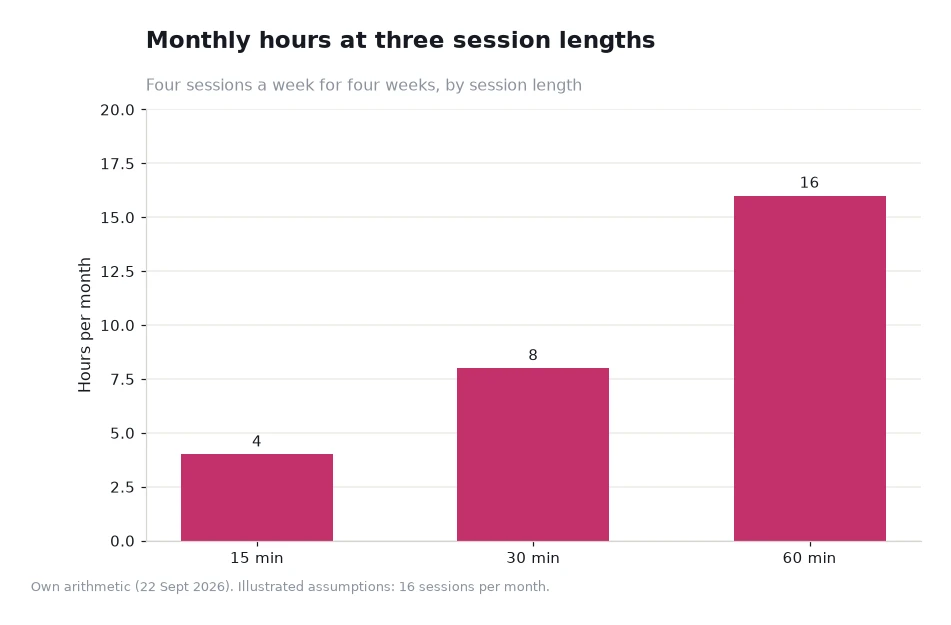
Start from the session pattern. Four sessions a week for four weeks is 16 sessions a month. At 15 minutes each, 16 × 15 = 240 minutes, or 4.0 hours. At 30 minutes, 16 × 30 = 480 minutes, or 8.0 hours. At 60 minutes, 16 × 60 = 960 minutes, or 16.0 hours. The chart beside this section plots those three figures, and they are illustrative assumptions rather than platform data.
Now add the message count, which is the measure that matters for a text product. At 40 messages a day across 30 days you generate 1,200 messages a month, so 1,200 × 12 = 14,400 in a year. Set that against the 8-hour monthly pattern and the same month is producing 150 messages an hour, or 2.5 for every minute of typing. A single year of regular use therefore produces a record smaller than a modest photo library, and one that is entirely made of words the reader wrote and read.
That comparison is the point of the exercise. Reasoning about a text footprint is straightforward; reasoning about an image library is not, because an image can circulate in ways its subject cannot track. Text-only generation does not make every question disappear, but it removes a whole class of them, and it does so by design rather than by policy.
What to read before trusting the claim
The claim is checkable in three places. The platform's own description at https://crushon.ai/ai-porn-chat sets out how the product presents itself and what its FAQ says about limitations — including what Porn Chat AI refers to, how realistic the responses are described as being, and which restrictions still apply under the content and community guidelines. The dated 2257 compliance statement carries the wording about AI-generated text and real persons, and the content removal policy shows how a concern about a profile is raised. Read in that order, the set answers the provenance question in about ten minutes.
Two habits make the reading durable. Check the date on the compliance page whenever you look, and keep a copy of the sentence you relied on. Documentation that changes is only useful if you can tell what it said when you made your decision, and both habits cost less than one short session. A reader who keeps those two quotes in a note ends up holding a better record of the platform's own claims than any summary written by someone else.
Frequently asked questions
Does the platform contain real people?
No. The compliance statement describes the content as AI-generated text and states that it depicts no real person, and it adds that the site does not produce images or video of its own.
Why does a text-only format matter for safety?
Because there is no media to circulate. A written exchange stays within the environment where it was produced, so the verification and consent questions that apply to images and clips do not arise in the same form.
How much do I actually generate in a year?
At 40 messages a day, about 14,400 messages, which is roughly 1,200 a month. It is a volume small enough to review, and any question about how it is retained or removed is answered through the published policies.
Check the disclosure, then the dates
Open the compliance statement, note its date, and read the sentence about how the content is produced. Then read the product page for what the platform says about its own behaviour, and keep the two quotes in your notes. Ten minutes spent that way replaces a set of assumptions about what an adult AI platform contains with two dated facts, which is a better basis for any decision that follows.
Data and sources: the platform's product description and its 2257 compliance statement[1], read 22 Sept 2026. Session, message and annual volume figures are illustrative assumptions, not platform data. Written for readers aged 18+.